

Fates, reports, and experiences of members of the crew of the armored ship ADMIRAL GRAF SPEE
after the ship was wrecked off Montevideo
Escape while loaded to the Plimsoll line
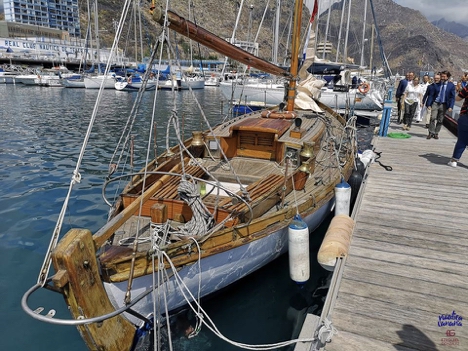
On a balmy summer evening sometime in December 1942, a sleek, “cutter style” just 30 foot long sailboat slipped its moorings at the San Fernando yacht harbor in the quasi tropical Tigre Delta region north of Buenos Aires. It’s tiny 10 horsepower auxiliary engine puttered quietly as it headed northeast into and across the Rio de la Plata toward Punta del Este, Uruguay.
|
Credit: MARIO SUÁREZ ROSA 09.10.2018 |
This boat “HALCŌN” (Eagle or Der Falke) had been entirely build in Argentina during the early 1930’s at the Döbler and Freres Shipyard. The purpose of the design specifications of the boat where to be able to participate in regatta racing competitions.
The owner and skipper was a longtime resident of Argentina and German citizen Dietrich Meybohm.
Herr Meybohm was an experienced sailing aficcionado. Heinz Förster wrote (Zugvogel auf langer Fahrt, 1985) that Meybohm had sailed the “Brema” for the 1936 Olympic Transatlantic regatta.
Meybohm also had a profitable wholesale coffee import and distribution business in Buenos Aires. The HALCŌN participated in a number of racing events, between Buenos Aires to Mar del Plata, Argentina and Punta del Este, Uruguay. Meybohm’s HALCŌN won most of these races.
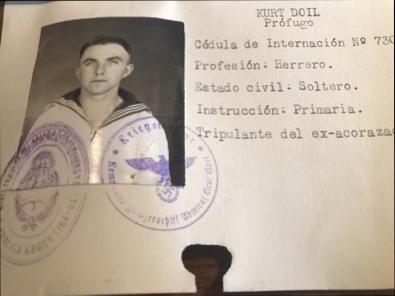
That late December evening, Meybohm’s German partners Großmann and Bösenberg where not on board as usual. It is not entirely clear exactly who else was around. Perhaps just Kurt Doil, who in April 1940 was an employee of Herr Meybohm’s coffee business at MBM calle Acevedo 1735 Buenos Aires and actually had lived in the bosses house. (Nominal list of German crew members with employment and address, Darsena Norte, 22 April 1940). Kurt Doil was a sailor from the ADMIRAL GRAF SPEE (a professional blacksmith and mechanic, with the rank of Maschinenobergefreiter).
Currently Doil was supposedly held as wartime internee ID No 730 on the island of Martin Garcia. It is not clear if Doil had escaped from Martin Garcia Island beforehand and traveled to San Fernando to hide on board as the ship left, or (most likely) if Mr Meybohm picked him up that night at a concerted time and place along the way to Uruguay in passing Martin Garcia island. That was actually a nighttime procedure that had been successfully used a number of times in organizing escapes from the island.
It just so happens, that Herr Dietrich Meybohm and his wife were also friends of ADMIRAL GRAF SPEE NCO Master carpenter Swaczyna, who had escaped from Martin Garcia Island just a short time before. (It can be safely assumed that Meybohms boat was a participant)
|
Doil’s Argentine Police and ADMIRAL GRAF SPEE Kommando Rollodex Identification Card |
It is not even certain what the exact date of the HALCŌN’s departure from Argentina was or when it arrived in Uruguay. However, Herr Maybohm and his little sailingyacht was well known by the Port authorities in Punta del Este. In fact he was famous there as the winner of many yacht races. His presence did not cause any further undue questions.
What is certain is that two additional german sailors were below the deck of the HALCŌN the 1st of February 1942 when it reportedly departed Punta del Este in Uruguay and went on to sail across the Atlantic. It has also been reported (but never verified) that exactly 68 days later (on the 14th of April 1942) this small sailboat arrived in the port of Santa Cruz de Tenerife, proudly flying the Argentine flag.
The Spanish authorities reported that the following four persons disembarqued: Meybohn, Helmut Griessmann, Kurt Werner and Kurt Dolls. None of them besides Meybohm carried any ID or had entry visas or the required vaccines. And the boat log and papers had no exit authorization from it’s port of departure or entry permits to the port of Tenerife.
Of course for starters the spelling on all four names is wrong. It can not be said if this was purposefull or not. It probably was. Spain was a neutral country, but the Franco government was solicitous to Germany (Spain wanted more modern armaments from the Reich). Spain was especially gratefull to the ADMIRAL GRAF SPEE for service during the civil war. (Of course on the victorious fascist side). In fact the news of this landing, which omitted all details were not published until a newspaper in Bremen, Germany briefly broke the news on October 14 1942, stating that one of the passengers was a “Kurt Tozorki” from Hamburg. Probably to avoid compromiosing Spanish neutrality and just to mislead the British. (Note: Mario Suarez Rosa in: El Regreso del HALCŌN”, El Apurón, 09/10/2018). But the British Admiralty already knew details long ago.
In any event, the HALCŌN’s skipper’s name was officially listed as either Maybohm or Meybohn, not Meybohm. Helmut Griessmann was not a ADMIRAL GRAF SPEE officer. His real full name was Helmut Giesmann Schreibendorff. He was the Number 3 Officer on the German merchant marine TACOMA a freighter of the German Company HAPAG which had been declared by the Uruguayan government a wartime auxiliary in assisting the ADMIRAL GRAF SPEE in aiding and abetting the escape of that whole tripulation from Montevideo to Buenos Aires. The entire crew of the TACOMA was held and interned in Uruguay along with the ADMIRAL GRAF SPEE crew. What is peculiar is that Giesmann’s escape from Uruguay was not oficially recorded until the 6th of February 1942. (See: Uruguay Archivo, Caja 2 , 1942 item 3: 6 de febrero. Falta del 3er Oficial Helmut Giesmann Schreibemdroff. (sic) 3 folios). The information about these names is quoted by Ronald C. Newton in his book The Nazi Menace in Argentina, pg 272, taken from a report by the British Naval Attaché in Buenos Aires to the Admiralty dated 7 May 1942 (see his note 28 pag 445).
Kurt Dolls was actually Kurt Doil.
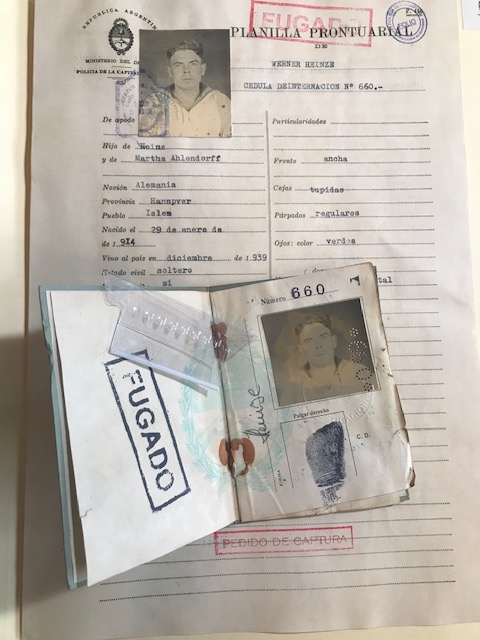
Kurt Werner’s original escape is a bit of a mistery. This author believes he was ADMIRAL GRAF SPEE Maschinenobergefreiter Werner Hinze, internee number 660 (7th Division for the ADMIRAL GRAF SPEE). A NARA list reports that he is on the list of escaped ADMIRAL GRAF SPEE sailors published by the Buenos Aires Police Dep. on July 27, 1943. However, his police Prontuario records the escape from his workplace in Buenos Aires sometime in February 194i. That would mean that he had stayed in hiding for over a year waiting for this opportunity. An order to capture him was issued. But no exact date or means of his escape from internment is known. In any event, he was gone for good from Argentina because he does not appear on the Highland Monarch repatriation list for the 26 February 1946. Moreover, His name was misspelled as Heinze in the Argentine and even American reports. His true name was Werner Hinze. It was also reported that he escaped by plane with the assistance of one Guillermo Mueller and that upon returning to Germany he was killed in Action. (NARA, see also HMA)
|
The HALCŌN was rated as just under 10 tons, and when it left was loaded to the gunwales with fuel for the diminutive 10hp auxiliary motor. (About the same size as the African Queen’s). (That engine was necessary because they were expecting lengthy becalmed seas...which indeed happened along with some wild and wooly storms). It also carried number of 200 liter stainless steel barrels of potable water installed by the German Company Rommel Talleres Metalúrgicos (Private information Dr. Gerardo Rommel) in addition to boxes of tinned food, hard tack bread, potatoes, lemons and lots of fruit (to last at least 3 months for 4 people). Topping it all of was the assorted spares including fishing gear, tools, engine parts and sails (expecting rip and tear storms (which also happened) and of course valuable bags of coffee.
There was a small load of canned peaches that seemed unusually heavy. Every nook and cranny was stuffed full. Personal clothing and gear was severely limited. A magnetic compass, sextant, binoculars, outdated charts and some prediluvian sailing instruments were kept on hand. The idea was to sail well distant from the usual Atlantic trade routes and avoid allied shipping. As it was, they sighted a number of ships including an American ship carrying a load of airplanes.
None of these 3 sailors except for the skipper knew anything about setting sail. They quickly learned after getting over their severe seasickness. However, since all three were competent mechanics they did manage to repair and restart the old auxiliary motor several times when it was sorely needed to move along and out of the becalmed zones. Their first leg was 5,600 miles.
But there is another question. That question is not so much who was on the trip, but what else Herr Meybohm carried along within his cargo in those peach cans... just for example.
Right about 1942, German and Italian Condor and LATI civilian aircarriers for postage, “diplomatic” cargo and a few passengers stopped operating from Argentina and Brazil as they had until 1942 while connecting to Europe over North Africa and the Canary islands. Yet, Argentina was an important entrepot for smuggling valuable essential materials to the Reich. Specifically Platinum, Wolframite and certain drug precoursors like quinine, cocaine etc.
Argentina itself was not a source for specific scarce and costly materials needed by the German war machine. However, products such as platinum used for example in the sparkplugs of advanced Messerschmidt planes could no longer be bought in the Soviet Union after the start of Operation Barbarossa. That had to be smuggled from Colombia through Ecuador, Peru and Chile onto Spanish ships loading in Argentina. (“See Argentina center for Axis smuggling” pgs 143-149 in H. R. 3662 US Holocaust Assets Commission Act of 1998. Us Printing Office. Wash. 1988. Serial No 105-62). Also (Richard L. McGaha “The Politics of Espionage: Nazi Diplomats and Spies in Argentina 1933-1945” Phd Dissertation, November 2009)
So what exactly was in those heavy sealed tin cans marked “peaches” that Herr Maybohm carted down the dock from the “HALCŌN”? One can just guess but it will never be known for certain now.
It may just be a coincidence that the British Navy did stop and thoroughly inspected a Spanish freighter coming north from Argentina and found several kilograms of Platinum in unusually heavy tin cans marked Peaches. Of course the Brits may already have known what to look for, thanks to “Magic” or another Argentine source. Those sealed cans may were well also have been manufactured by the Rommel Talleres Metalürgicos S. A. that also installed the stainless steel drinking vessels in the HALCŌN. (But that is just a guess.)
Be all of that as it may, the 3 sailors and their “baggage” were quickly picked up by German airplanes. Herr Maybohm decided to keep on sailing solo to Gran Canaria, His plan was to sell his boat there and like the true patriot that he was, head to Germany to offer his services in the war effort.
Not so fast!! said the port authorities. Your boat can not leave port without papers. So in the end it was sold to the local Spanish Royal Nautical club in Tenerife and Herr Maybohm went on to Bremen with 42.000 pesetas in his pocket.
That is not the end of the story for Herr Meybohm. He did his duty during the whole war. At the end of the war, he made a modest living, taking British and American officers on sightseeing outings around Bremen and even to Hamburg. Somehow, that job put him in contact again with Herr Heinz Förster, whom he had already met in Argentina in 1936. Heinz was a superb sailor who had taken a diminutive sailboat before the war with just his wife all over the Atlantic for a year long sailing trip. (Zugvogel auf langer Fahrt 1985).
After the war, Heinz Förster had access and a job to repair another smallish sailboat in the utterly destroyed and bombed out port of Hamburg. It was a two masted sailboat. Ever so cautiously while doing repairs Förster and Meybohm asembled a small crew of former naval officers including an U-Boot sailor while gathering and loading a respectable pile of foodstuffs on bord. (This was extremely hard to do in the immediate postwar period while there was strict food rationing). In the end, Heinz Förster and Meybohm had a full load of twenty passengers which included one woman.
One fine evening they stole the boat and sailed off through the darkness on the Elbe river out into the north sea. Course heading back to Argentina.
(NOTE): At the end of World War II, Meybohm was in Bremen, where he sailed a boat with which he took British and American officers occupying Germany out to sea. These friendships enabled him to acquire a more seaworthy vessel, the OLINDA, on which he one day embarked twenty Germans and fled to Argentina, after managing to evade the British blockade. On the way, he stopped in Tenerife to see his beloved HALCŌN. Report by Hernán Álvarez Forn, president of the Argentine Classic Boat Association. (That note is incorrect in that it was Förster who had use of the boat).
The voyage was “difficult” even with their experienced crew. Förster was the actual “owner” as the acknowledged captain of the sailboat (which he renamed OLINDA once at sea). Meybohm was second in command. They managed to evade a still ongoing British blockade in the Channel.
The OLINDA ever so briefly stoped over in Tenerife but soon food and especially water was insufficient. Fortunately it rained and they refilled all their water containers at sea. They had some fishing gear but not much luck with it. Some unfortunate flying fish were plopping on board. They carefully skipped Rio and bypassed Punta del Este and Montevideo. Eventually in broad daylight, flying a handmade Argentine Flag they slipped right up the Rio de la Plata into the yacht harbor of San Fernando either bypassing and/or through the channels they both already knew so well.
Who knows the names of the passengers? They all quickly disembarked and disappeared into a city of millions.
And there the OLINDA sat in drydock for many years. Of course Herr Förster was penniless (His perenial condition). There was no money for the scrubbing, painting and repairs except by volunteers (including this author) on the promise for future adventures, a long sailors yarn and free “bife de Chorizo” steak lunch. More important, the boat had no flag and no papers at all. Förster was forbidden to take it out on the water until he straightened it all out (That means just to get started cash under the table in Argentina).
|
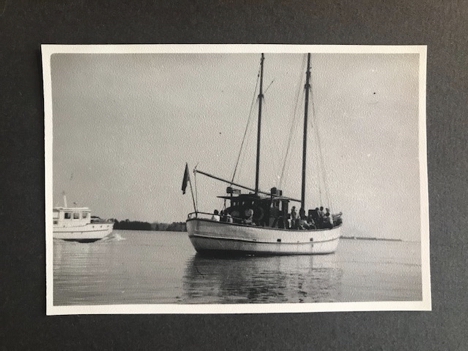
The OLINDA circa 1956 heading out into the Rio de la Plata |
Eventually it all worked out (The Argentine way) and the boat was launched into the Tigre Delta. This author was actually on board with his parents on that fine summer day first outing. We sailed up the river, stopped at a sandbank island close to the Uruguay border channel, went swimming in the current, had a steak lunch and a great old time.
Among the 18 passengers was a former aviator. When we went swimming I was surprised as he took off his prothese from his leg. I was amazed how well he could swimm with just one leg. His name: Rudel. Also on board 2 former crewmen from the ADMIRAL GRAF SPEE, including Wilhelm Rasenack and his (first) wife, who I knew quite well since they frequently visited with my parents and still lived in Buenos Aires.

|
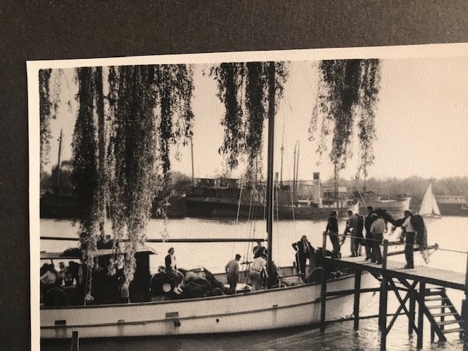
Lunch on the OLINDA sailing in the Paraná river. (Photo: Carlos Benemann) |
|
Loading up on the OLINDA in the Tigre Delta. (circa 1956) |
A couple of years later about 1958, Heinz Förster decided to take the OLINDA on a fishing expedition through the straights of Magellan all the way to northern Perú. Yours truly was invited but declined. (My girlfriend objected) Years later Förster took the OLINDA from the north coast of Perú through the Panama canal to go fishing of Bluefields in Honduras. The boat was seriously damaged on a reef just on the Misquito coast. Förster decided to go home to Hamburg with his wife. In 1985 I visited them there.
The OLINDA was rescued, refitted, renamed and again sailed through the Panama Canal back into the Pacific heading to California. In 2001 I heard it ended up in Sausalito, California now under the name “Der Wandervogel”.
For all I know it is still there.
(NOTES:)
Several of the German ship's officers imprisoned on Martín García Island, in the Río de La Plata, were freed, with the collusion of the prison guards, because it was not easy to escape from that prison, by a German coffee importer based in Buenos Aires named Dietrich Meybohm, a very good sailor and fervent Germanophile.
Meybohm, as a keen lover of the sea, had a sailboat called “HALCŌN” (Falcon) which he equipped for a long voyage that would take them back to Germany. On February 1, 1942, he departed from Punta del Este (Uruguay), arriving at the port of Santa Cruz de Tenerife on April 14. Meybohn, Helmut Griessmann, Kurt Werner, and Kurt Doll disembarked at this port.
They had sailed 5,600 miles nonstop, following a route that avoided encounters with Allied ships, both merchant and military, so that, taking advantage of the prevailing currents and winds, he moved away from the American coast and headed north across the middle of the Atlantic. Meybohm would later recount that his legendary traveling companions, the officers of the ADMIRAL GRAF SPEE, were magnificent professional sailors but knew nothing about sailing and suffered terribly from seasickness.
The press at the time did not report on the voyage until many months later, when it did so with a news item from Bremen (Germany) in which, conveniently, the true identity of the sailors was concealed and no details were given about the reason for such an unusual voyage, presumably so as not to compromise Spain's supposed neutrality:
FOUR GERMANS CROSS THE ATLANTIC ON BOARD A SMALL YACHT
Bremen, 14, 10 p.m. (S. E. T.) On board a small sailing yacht equipped with a ten-horsepower auxiliary engine, four Germans have crossed the Atlantic from Buenos Aires to Santa Cruz de Tenerife, taking sixty-eight days to complete the journey despite unfavorable weather conditions. The crew consisted of the yacht's owner, Dirk Meybohm, a native of Bremen who had been living in Argentina since 1925; the third officer of the Hapag Company's steamship TACOMA, Giessmann; Kurt Doin, an employee of the Meybohn trading company in Buenos Aires; and a Hamburg native named Kurt Tozorky. During the voyage, the yacht's crew sighted five steamers, including a 6000-ton American vessel loaded with aircraft. West of the Cape Verde Islands, the sailboat unexpectedly found itself in the middle of a pod of whales, one of which came dangerously close to the vessel.
A Nazi secret service plane went to pick up the officers, while Meybohm attempted to sail the boat to Gran Canaria, as the Royal Yacht Club on that island was interested in purchasing it for 42,000 pesetas.
Upon learning of this fact, several members of the Real Club Náutico de Tenerife contacted the Argentine consul to prevent its departure from the port of Tenerife. After raising 40,000 pesetas, they purchased it from Meybohm, who returned to Germany.
From then on, and for almost 30 years, the “HALCŌN” was the flagship of the Tenerife Yacht Club, participating in countless regattas such as the San Ginés, where it won two editions (1948 and 1949) and held the record for the crossing for 18 years.
This boat had bad luck because in 1954, while participating in the San Ginés Regatta, it ran aground on the north coast of Fuerteventura while sailing, retired, towards Arrecife. The reason was a chain of misfortunes.
This accident brought to light a detail that is undoubtedly the result of its eventful life, namely that the “HALCŌN” had no papers, as it was never registered in Spain. As a solution, it was decided to camouflage it with the name of another boat that had run aground in the same place, called the “FAMARA” until, some time later, this irregular and peculiar situation was finally resolved.
At the end of World War II, Meybohm was in Bremen, where he sailed a boat with British and American officers who were occupying Germany. These friendships enabled him to acquire a more seaworthy vessel, the OLINDA, on which he embarked twenty Germans and fled to Argentina, after successfully evading the British blockade. On the way, he stopped in Tenerife to see his beloved HALCŌN. Report by Hernán Álvarez Forn, president of the Argentine Classic Boat Association.
(Text source: Carlos Benemann, translated with DeepL with few corrections)